Competition
Powerlifting Rules and Commands for Squat, Bench Press, and Deadlift
Learn the squat, bench press, and deadlift commands, spot common no-lift risks, and build a repeatable meet-day rehearsal routine.
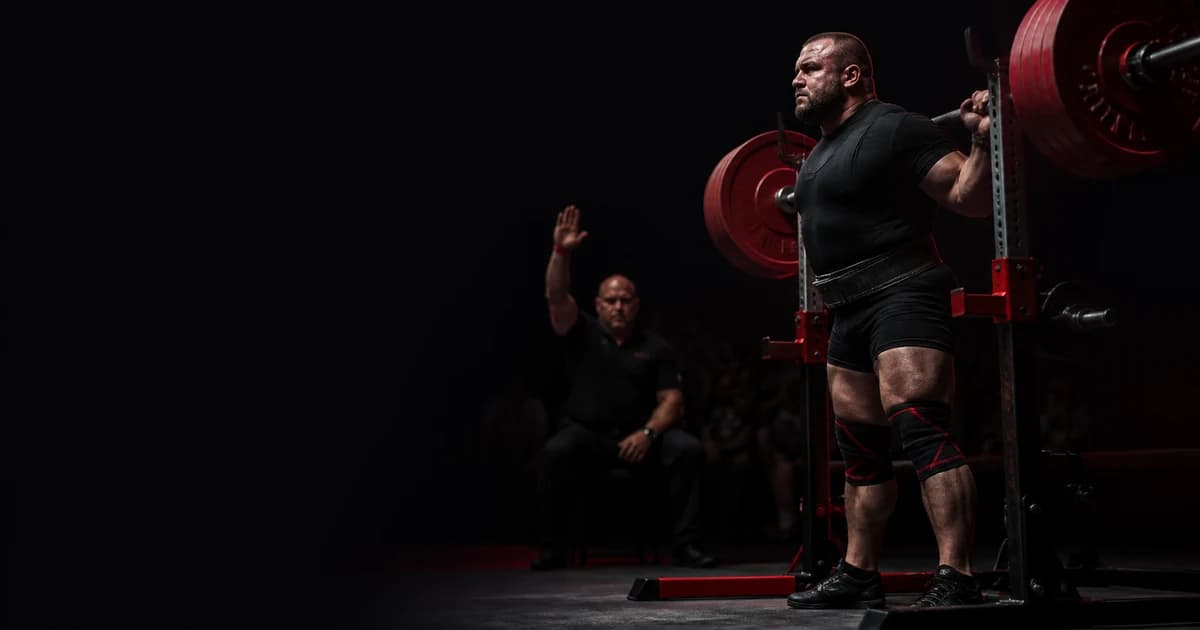
In an IPF-style powerlifting meet, wait for the “Squat” and “Rack” commands during the squat, “Start,” “Press,” and “Rack” during the bench press, and “Down” during the deadlift. Completing the physical lift is not enough. You must reach the required positions, respond to each command, and control the bar throughout the attempt. Read your federation’s current rulebook because commands, equipment standards, and judging details can differ.
Powerlifting command sequence
| Lift | Command sequence | What you must demonstrate |
|---|---|---|
| Squat | Squat, then Rack | Establish the start position, reach legal depth, stand with locked knees, and wait before reracking |
| Bench press | Start, Press, then Rack | Hold the start position, pause the bar as required, press to locked elbows, and wait before reracking |
| Deadlift | Down | Stand erect with locked knees, hold the finished position, and control the bar to the platform after the signal |
The deadlift has no spoken start command. You begin when you are ready after the bar is loaded and the platform is called ready. The head referee gives the “Down” signal only after you reach the required finished position and the bar is motionless.
These sequences describe common IPF rules. Do not assume that another federation uses identical technical standards. Check its current rules, meet information, and instructions from the officials.
How referees judge an attempt
Three referees usually observe an attempt from different positions. Each referee gives a white light for a good lift or a red light for a no lift. You need at least two white lights.
A referee’s decision covers more than the heaviest-looking part of the repetition. The complete attempt includes:
- Your position before the first command.
- Your response to each command.
- The lift’s required range of motion.
- Bar and body movement during the repetition.
- Your final position.
- Your control of the bar until the attempt ends.
One recording cannot reproduce all three referees’ views. Use video to identify visible risks, not to announce a definitive platform decision. The video-analysis methodology explains how to separate an observation from an interpretation.
A repeatable rules-review method
Use the same observation, decision, and revision loop for every competition lift.
1. Observe
Write down only what the recording shows. Useful observations include:
- The knees appear extended before the squat command.
- The hip crease is obscured by the lifter’s arm.
- The bar becomes motionless on the torso before the press command.
- The left elbow appears to unlock after reaching extension.
- The bar moves downward during the deadlift ascent.
- The lifter begins lowering the bar before the down signal.
Do not turn an uncertain view into a fact. Write “the near hip crease is not visible” instead of “the squat was high” when the camera cannot show the relevant relationship.
2. Decide
Choose one rule-related risk to address. Give priority to errors that could invalidate an otherwise completed attempt, such as missing a command or failing to establish the required start position.
3. Revise
Change one controllable action during the next technical set. Examples include holding the finished squat for a full command rehearsal, moving the camera to reveal the hip and knee, or asking a training partner to vary the bench pause before saying “Press.”
4. Retest
Record another set under the same useful conditions. Compare the selected point instead of searching for every possible fault at once.
Squat rules and commands
After you unrack the bar, establish the required start position. Under IPF rules, you must stand erect with your knees locked before the head referee gives the “Squat” command and downward arm signal. Do not begin descending while you are still settling your stance.
After the command, descend until the top surface of each leg at the hip joint passes below the top of the corresponding knee. The practical review question is whether the visible hip crease passes below the visible top of the knee. Use the powerlifting squat depth guide for a focused depth review.
Stand back up without an additional downward movement of the bar. Finish erect with your knees locked. Hold that position until the head referee says “Rack” and moves an arm backward. Only then move toward the rack.
Common squat no-lift risks include:
- Starting or finishing without locked knees.
- Failing to reach the required depth.
- Allowing the bar to move downward during the ascent.
- Taking a step after receiving the squat command.
- Receiving assistance from a spotter during the attempt.
- Reracking before the rack command.
- Dropping or dumping the bar instead of returning it safely with the spotters.
Foot pressure can shift without creating a visible step. Review actual foot displacement rather than interpreting every heel or toe movement as an automatic failure.
Bench press rules and commands
Set up with your head, shoulders, and buttocks in contact with the bench. Place your feet in the position required by the federation and meet setup. Establish your grip within the permitted width.
After the handoff, hold the bar at arm’s length with your elbows locked. The head referee gives the “Start” command when you have established the required position. Lower the bar only after that command.
Bring the bar to the chest or abdominal area and hold it motionless. The referee then says “Press.” Press the bar to arm’s length with both elbows locked. Hold the finished position until you hear “Rack.”
Current IPF bench rules also include a depth requirement based on the relationship between the underside of each elbow joint and the top surface of the corresponding shoulder joint at the bottom position. Consult the current rulebook for the exact wording and applicable diagrams.
Common bench no-lift risks include:
- Lowering the bar before the start command.
- Pressing before the press command.
- Failing to make the bar motionless on the torso.
- Failing to reach the required bottom position.
- Allowing the bar to move downward during the press.
- Failing to lock both elbows at completion.
- Raising the head, shoulders, or buttocks from the bench when the rules require contact.
- Moving the feet in a way that violates the federation’s standard.
- Letting the bar contact the rack or spotters in a way that assists the lift.
- Reracking before the rack command.
A deliberate pause in training should teach you to hold position and listen. Do not memorize one fixed pause length. The referee’s command follows the observed position, not a timer you can predict. Review bench press bar path and bench press leg drive separately when either issue affects your setup or control.
Deadlift rules and the down command
The deadlift begins without a start command. Grip the bar and lift when you are ready.
Complete the attempt by standing erect with your knees locked and shoulders in the required finished position. Hold the bar motionless. The head referee then says “Down” and gives a downward arm signal.
After the signal, return the bar to the platform under control with both hands. Do not release it and let it fall.
Common deadlift no-lift risks include:
- Failing to stand erect with locked knees.
- Allowing the bar to move downward before reaching the finished position.
- Supporting the bar on the thighs during the ascent.
- Stepping during the attempt.
- Lowering the bar before the down command.
- Releasing the bar instead of maintaining control to the platform.
A stalled bar is not necessarily the same as a downward-moving bar. Review the plates or a fixed point on the bar frame by frame before describing the direction. For a focused finish review, see the deadlift lockout guide.
Compact decision table
| Visible observation | Decision | Next rehearsal |
|---|---|---|
| Squat depth cannot be seen because the arm covers the hip | Do not judge depth from that clip | Move the camera slightly behind the side view |
| Knees remain soft before the squat command | Treat the start position as the first priority | Lock the knees, become still, then cue “Squat” |
| Bench bar touches the torso but never becomes still | Rehearse command readiness | Hold the bar motionless until a partner gives “Press” |
| One elbow appears bent at the bench finish | Confirm with a clearer rear-side view | Use a manageable load and hold the lockout |
| Deadlift reaches lockout, then drops before “Down” | Treat command discipline as the revision | Hold the finish until an intentionally delayed signal |
| Bar path leaves the frame | Make no conclusion about the missing phase | Refilm with the full bar and plates visible |
Worked example: reviewing a bench rehearsal
Suppose a lifter records a bench press from a front-side angle. The bar reaches the torso, pauses briefly, and rises smoothly. The lifter racks it as soon as both elbows appear extended.
A vague review might say, “The bench looked good.” A rules-based review is more useful:
Observation: The recording shows a motionless bar before the press begins. Both elbows appear extended at the top. The lifter starts moving the bar toward the rack immediately after reaching extension. No audible rack command is present.
Unknowns: The angle does not clearly show whether both shoulders and the buttocks maintained contact. It also cannot confirm what a referee on the opposite side could see.
Decision: Prioritize the missing rack-command rehearsal. Do not claim that the entire lift would receive white lights.
Revision: During the next light technical set, ask a partner to give “Start,” “Press,” and “Rack.” The partner should delay the final command until the lifter has visibly stabilized the bar.
Retest: Record from the same angle. Check whether the lifter holds locked elbows and waits for the rack command without drifting toward the uprights.
This method produces one testable correction while preserving uncertainty about evidence the camera did not capture.
Film commands and positions clearly
Use a stable camera and keep your entire body, bar, plates, rack, and relevant points of contact in frame. Avoid an extreme low angle because it can distort squat-depth relationships. Avoid placing the camera directly in front when plates obscure the knees or hips.
For squat depth, a side-rear position can show the near hip crease and knee while reducing obstruction from the arm. For bench press, a front-side view can show bar movement, elbow extension, torso contact, and some foot movement. For deadlift, a front-side view can show the knees, hips, shoulders, bar, and hands through the finish.
Record audible commands when possible. Without audio, a reviewer may see when you moved but cannot establish when an off-camera referee or partner spoke.
Video can show positions, timing, visible bar direction, and some contact changes. It cannot establish:
- Pain or the absence of pain.
- Your internal sensations.
- Your intent.
- The exact resistance when plates or records are unavailable.
- Your true RPE unless you report and log it.
- The source of fatigue.
- Whether an obscured body part maintained contact.
- Events outside the frame.
- The decision that three platform referees would make.
After you have identified one visible rules risk, Powerlifting AI: Gym Coach can review recorded squat, bench press, and deadlift video and provide technique feedback. Upload your next command-rehearsal set, then choose one visible setup or execution point to test in the following session.
Common rehearsal errors
Practising commands only during heavy singles
Heavy attempts add fatigue and consequence when you are still learning the sequence. Practise commands during selected warm-ups and manageable technical sets so the procedure becomes familiar without requiring repeated maximal attempts.
Giving commands at predictable intervals
If a partner always says “Press” after exactly one second, you may start anticipating the word. Ask the partner to vary the legal pause and wait until the required position is clear.
Reviewing too many variables at once
A clip may show stance movement, inconsistent depth, and a rushed rack command. Choose the issue most likely to invalidate the attempt, revise it, and record again.
Treating sensation as visible evidence
“The pause felt long” does not show that the bar became motionless. “The deadlift felt locked” does not establish visible knee extension. Record sensations in your training log, but keep them separate from the video observation.
Confusing gym completion with a good lift
Standing up with a squat, pressing a bench, or locking out a deadlift does not settle the rules question. Commands, position, range of motion, and control still matter.
Using one rulebook for every meet
Confirm the sanctioning federation and current rules. USA Powerlifting maintains its own rulebook and bylaws, while the IPF publishes separate technical rules. Do not combine their wording casually.
Connect rules practice to meet preparation
Command rehearsal belongs inside a larger competition plan. Confirm rack heights, equipment requirements, weigh-in procedures, attempt-card deadlines, and event-specific instructions before meet day. Use the attempt-selection guide to separate load choice from technical validity.
Choose an opener you can execute while following every command. A weight that you can lift in the gym may still be a poor opener if you repeatedly lose position or rush signals. If you are preparing across several weeks, coordinate rules rehearsal with your meet peak instead of adding unnecessary heavy attempts at the last minute.
Safety limits
Use secure racks, collars, and appropriate spotters for squat and bench press practice. Set safety arms or straps correctly when the equipment supports them. Do not sacrifice a safe bar return merely to imitate a platform sequence.
Stop the set if you experience pain, sudden weakness, dizziness, or another concerning symptom. A recording cannot diagnose the cause. Seek appropriate medical guidance for pain or injury concerns, and use a qualified powerlifting coach when you need individualized technical or competition support.
Final meet-command checklist
Before the meet:
- Confirm the federation and current rulebook.
- Read the meet director’s instructions.
- Check approved equipment and clothing requirements.
- Record rack heights where the meet procedure allows it.
- Rehearse all commands with a partner.
- Practise holding each start and finish position.
- Review one visible rule risk at a time.
- Choose attempts separately from judging your technical validity.
For the squat:
- Establish an erect start position with locked knees.
- Wait for “Squat.”
- Reach the required depth.
- Stand erect with locked knees.
- Wait for “Rack.”
For the bench press:
- Establish all required points of contact.
- Hold the bar with locked elbows.
- Wait for “Start.”
- Make the bar motionless on the torso.
- Wait for “Press.”
- Finish with both elbows locked.
- Wait for “Rack.”
For the deadlift:
- Begin when ready.
- Avoid downward bar movement during the ascent.
- Finish erect with locked knees.
- Hold the bar motionless.
- Wait for “Down.”
- Control the bar to the platform with both hands.