Technique
How to Use Bench Press Leg Drive Without Lifting Your Hips
Set your feet, build steady leg drive, keep your hips on the bench, and review each rep with a repeatable powerlifting method.
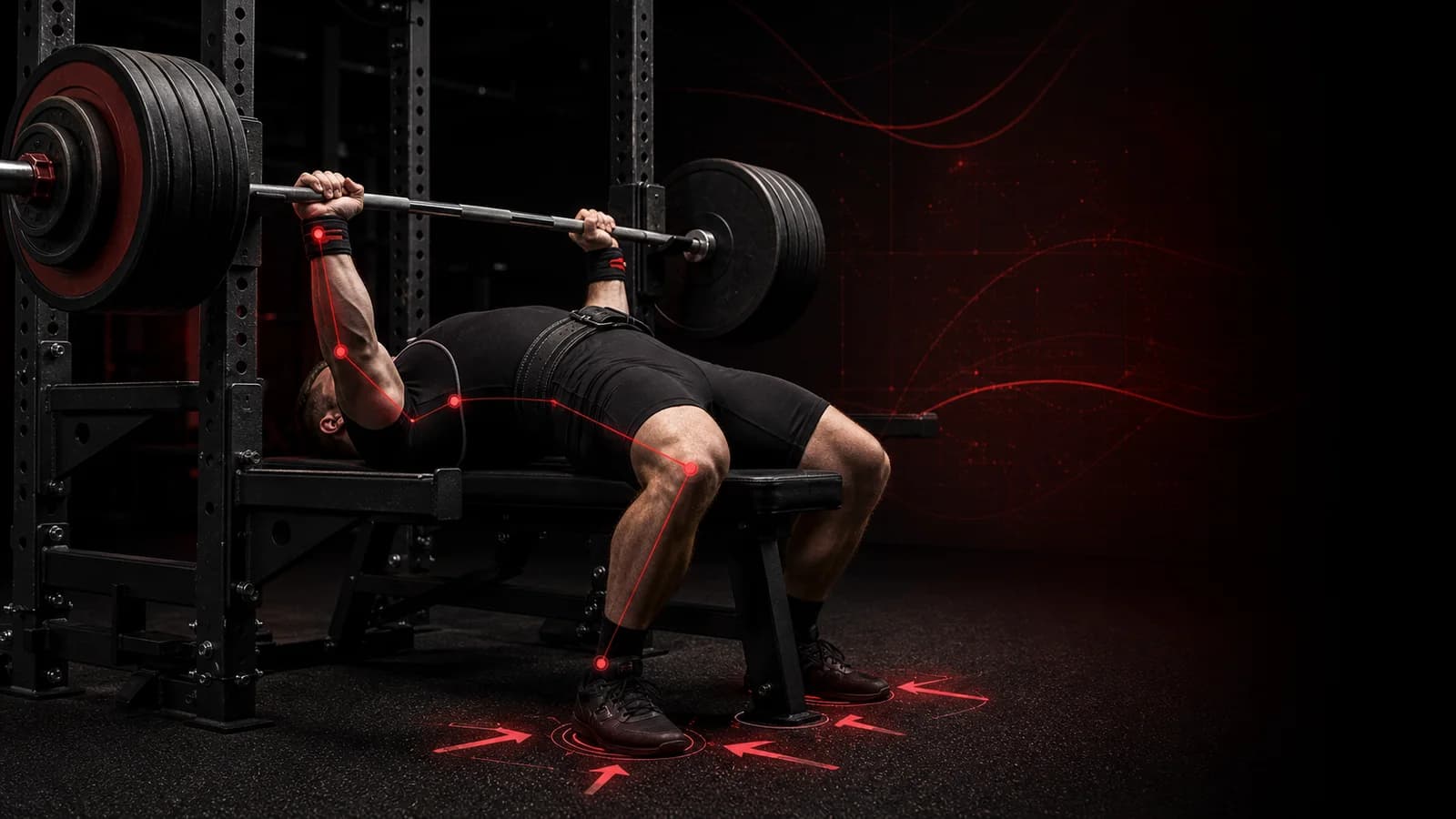
Bench press leg drive means pushing through your planted feet to keep your torso stable and your upper back firmly positioned while you press. Set your feet before the handoff, build floor pressure before you lower the bar, and direct that pressure toward the head of the bench without lifting your hips. You want a stable base, not a hip thrust.
Use a competent spotter or correctly positioned safeties whenever a missed rep could trap you. Secure the plates with collars. Practice each setup change with a light load before you use it during heavy training.
What leg drive should accomplish
Leg drive should help you maintain the position you established before the unrack. When you apply it well, you can usually observe three things:
- You keep both feet planted through the full repetition.
- You maintain contact between your buttocks and the bench.
- You keep your torso position consistent from the handoff to the rack command.
Leg drive does not need to produce obvious movement. You may apply considerable pressure while remaining almost motionless. Treat stability as the goal and movement as evidence that you may need to revise the setup.
Under the current IPF technical rules, you must maintain contact between your head, shoulders, buttocks, and the bench. You must also keep your feet flat on the floor, as flat as your footwear allows. The rules permit foot movement only while you keep each foot flat. Other federations may apply different standards or interpretations. If you compete in USA Powerlifting, check the current USA Powerlifting rulebook page before your meet.
Build your bench press setup in a repeatable order
Changing your grip, foot position, arch, and handoff at the same time makes review difficult. Use the same sequence for every setup attempt.
1. Position yourself under the bar
Lie down with your eyes approximately under the bar or slightly toward the foot end. Your exact position depends on the rack geometry and whether you receive a handoff.
Choose a position that lets you clear the hooks without turning the unrack into a press. If you have to reach far behind your head, you may lose the torso position you established.
2. Set your contact with the bench
Pull yourself into position and keep your head, shoulders, and buttocks in contact with the bench. Establish an arch that you can maintain without pain and that complies with your federation’s rules.
Do not chase the largest possible arch if you cannot repeat it. A smaller, stable position gives you more useful information than an aggressive position that changes during every rep.
3. Choose and secure your grip
Place each hand at a repeatable point on the bar. Wrap your thumbs around the bar unless your rules or qualified coach direct you otherwise, and keep your wrists positioned so you can control the load.
Your grip influences your touch point, elbow position, and range of motion. Keep it fixed while you test foot positions.
4. Place your feet
Start with a moderate position. Place your feet far enough back to create tension, but not so far back that you cramp, lose full-foot contact, or lift your hips when you push.
Your proportions, ankle mobility, bench height, footwear, and federation rules all influence the position you can use. Some lifters keep their lower legs close to vertical. Others place their feet farther behind their knees. Neither position automatically creates better leg drive.
5. Build pressure before the handoff
Press both feet into the floor before you take the bar. Think about pushing your body toward the head of the bench while you keep your buttocks in contact with the pad.
Maintain this base while your spotter hands you the bar. If you wait until the bar reaches your chest before using your legs, you will probably produce a sudden kick instead of steady support.
For a broader review process, use the powerlifting video analysis guide alongside the site’s methodology.
Connect leg drive to the repetition
Treat leg drive as continuous pressure with a controlled increase, not an on-and-off command.
During the unrack, keep your foot pressure steady while you bring the bar over your starting position. Avoid reaching so aggressively that you lose your upper-back position.
During the descent, continue pressing into the floor. Lower the bar under control to your chosen touch point. Do not relax your legs because the bar is moving downward.
At the pause, maintain pressure without lifting your hips or heaving the bar into your torso. A competition pause does not require you to release tension.
During the press, increase floor pressure smoothly as you drive the bar away from your chest. Keep pressing in the direction that holds you toward the head of the bench. If you push primarily upward, you may lift your hips.
Review your pressing direction separately from your leg drive. The bench press bar path guide explains how to examine the bar from touch to lockout without treating every change as a leg-drive problem.
Use visible evidence without guessing
A recording can help you compare positions and timing. It cannot tell you everything that happened during the rep.
| You can observe in a suitable recording | You cannot establish from video alone |
|---|---|
| Whether you visibly break contact between your buttocks and the bench | How much force you applied through each foot |
| Whether you shift, turn, or lift a foot | What leg-drive direction you intended |
| When visible lower-body movement begins relative to the press | How difficult the load felt |
| Whether your touch point or bar path changes between reps | Whether fatigue caused the change |
| Whether you lose your starting torso position | Whether discomfort represents an injury |
Ask the lifter what they intended and felt. Record load, repetitions, RPE, rest time, and any discomfort separately. Do not infer pain, fatigue, confidence, or muscular effort from facial expressions or bar speed alone.
Anything outside the frame remains unknown. If the camera cuts off a foot, you cannot confirm full-foot contact. If plates hide the hip-to-bench contact point, you cannot confidently judge whether the lifter maintained it.
Film leg drive so you can review it
Use a stable camera position. Do not ask a person to walk around the bench while you lift.
For your primary angle, place the camera at approximately bench height on the side. Frame the bar, torso, bench surface, hips, knees, and both feet if the room allows. Keep the camera far enough away to reduce perspective distortion.
A rear three-quarter angle can help you compare left and right foot placement. It can also show whether you rotate on the bench. This angle may hide the hip-to-bench contact point, so use it as a second view rather than your only evidence.
Keep these variables consistent when you compare clips:
- Camera position and zoom
- Bench and rack
- Footwear and floor surface
- Handoff method
- Load and repetition target
Film at least two technically manageable reps. A single repetition may capture an unusual handoff or adjustment. Compare the same phase of each rep, especially the moment before the unrack, the touch, the start of the press, and the lockout.
Make one decision from each review
Use this compact table after watching the clip. Change only one major setup variable before you film again.
| Visible observation | Likely setup issue to test | Next revision |
|---|---|---|
| You lift your hips as you begin the press | You may have tucked your feet too far back or pushed too vertically | Move both feet slightly forward and repeat with a light load |
| You shift a foot during the descent | You may lack reliable floor contact | Widen or advance the foot position and mark it before the next set |
| You lose torso position during the handoff | The rack position or handoff may pull you out of place | Adjust your position under the bar or ask for a more controlled handoff |
| You kick suddenly after the pause | You may have delayed leg drive until the press | Build pressure before the unrack and maintain it during the descent |
| You maintain contact but the bar drifts toward your abdomen | The press direction may need review | Keep the foot setup and review bar path before changing leg drive |
Do not treat the middle column as a diagnosis. It gives you a variable to test. Film the revision and decide from the new evidence.
Worked example: test two foot positions
Suppose you film three paused bench repetitions with a manageable load. You use the same grip, bench, handoff, camera angle, and pause standard for each set.
In Set A, you place your feet far behind your knees. The video shows full-foot contact before the unrack. As you begin the second and third presses, you lift your hips slightly from the bench.
Your sensation was “strong leg drive,” but the visible evidence shows that you could not maintain legal bench contact. The recording cannot establish whether you pushed too hard, pushed in the wrong direction, or simply chose a position you could not control.
For Set B, move both feet slightly forward. Do not change your grip or arch. Build pressure before the handoff and push toward the head of the bench during each press.
The second recording shows that you maintain hip contact and keep both feet planted. The bar follows a similar path on all three repetitions. You report that the position feels less aggressive but easier to repeat.
Your decision is not that Set B will always produce a stronger bench. You can only conclude that Set B gave you a more stable, repeatable position under those conditions. Keep it for the next technique session, then test it across several manageable sets before using it with heavier loads.
Common errors and specific corrections
You pull your feet back as far as possible
A more aggressive tuck does not automatically create better leg drive. If you cannot keep your feet flat, maintain hip contact, or hold the position without cramping, move your feet forward.
You wait for the press command before using your legs
This often produces a sudden kick. Set your feet and build pressure before the unrack. Keep that pressure during the descent and pause, then increase it smoothly during the press.
You push straight upward through your feet
An upward push can lift your hips. Direct your effort so you hold your body toward the head of the bench while maintaining contact with the pad.
You change several variables after one poor rep
If you alter your grip, touch point, foot position, and handoff together, you cannot tell which revision affected the next rep. Change one variable, record it, and compare it with the previous clip.
You judge technique from sensation alone
A stable rep may feel less forceful than an unstable one. Pair your sensation with visible evidence. Write down what you intended, what you felt, and what you can actually observe.
Use drills without turning them into tests of strength
Choose a load that lets you maintain control and stop well before failure. Use a spotter or safeties.
Try a paused-leg-drive drill:
- Set your feet and establish all bench contact points.
- Build steady floor pressure before the unrack.
- Lower the bar to your normal touch point.
- Hold the bar motionless while you maintain the same foot pressure.
- Press without lifting your hips or shifting a foot.
Use one to three technically controlled repetitions per set. The drill should help you observe timing and position. It should not exhaust you or prove how much discomfort you can tolerate.
You can find broader training and technique resources in the powerlifting guide and review meet preparation separately in the peaking guide.
Know when to stop the review
Stop the set if you cannot control the bar, your spotter cannot assist safely, the bench or rack moves, or a foot repeatedly slips.
Stop training and seek appropriate medical guidance if you experience sharp or escalating pain, numbness, sudden weakness, dizziness, chest pain, or another concerning symptom. A video cannot diagnose the cause of pain. Technique feedback cannot replace a qualified healthcare professional or an experienced coach who can assess you directly.
Do not force a competition-style setup that causes pain. A rule-compliant position still needs to suit your current mobility and training status.
Final bench press leg-drive checklist
Before the unrack:
- Set your grip, torso position, and feet in the same order.
- Confirm that you can keep your required contact points.
- Build steady pressure through both planted feet.
- Position your spotter or safeties.
- Start recording from a useful angle.
After the set:
- Check foot placement, hip contact, and movement timing.
- Separate visible evidence from intent and sensation.
- Record the load, repetitions, RPE, and discomfort.
- Choose one variable to revise.
- Film the revised setup before adding weight.