Meet preparation
Your First Powerlifting Meet: What to Expect and Bring
Get through your first powerlifting meet: weigh-in rules, openers near 92% of your best, jumps from 93,333 lifters, a packing list and a meet-day clock.
At your first powerlifting meet you weigh in no earlier than two hours before lifting starts, declare your three openers, then take three attempts each at the squat, the bench press and the deadlift, and your best good lift of each adds up to your total. Open with a weight you would hit on a bad day, take moderate jumps, and go for nine good lifts out of nine: a first meet rewards lifts that count.
This guide walks you from the last 12 weeks to the final deadlift. You get the weigh-in and attempt rules from the IPF Technical Rulebook, which most federations follow closely, the opener and jump numbers from studies of tens of thousands of meet entries, a packing list and a clock for the day itself. Check your own federation's rulebook too: the details below change between federations.
Pick a meet you can train for
Give yourself 8 to 12 weeks. That leaves room for a normal training block, a peak and a taper, and it gives you time to join the federation and enter before registration closes. Pick a federation whose rules match how you train: tested or untested, raw (classic) or equipped. Our guide to starting powerlifting compares the choices.
Enter the weight class you already weigh. Under the IPF rules you nominate your class 21 days before the meet and may only weigh in for that class, so pick it from your morning bodyweight, not from a goal.
Plan the last 12 weeks
Survey data show how experienced lifters peak. Travis and colleagues asked 364 North American raw powerlifters how they taper:
| Time before the meet | What most lifters did |
|---|---|
| 5 to 8 weeks out | Their highest training volume |
| 2 weeks out | Their highest training intensity |
| 7 to 10 days out | Last heavy squat and deadlift, at 90 to 92.5% of their max |
| Under 7 days out | Last heavy bench press |
| Last 7 to 10 days | A step taper that cut volume by 41 to 50% |
| About 3 days out | Complete rest from training (2.8 days on average) |
A small trial by Burke and colleagues backs the short rest at the end. After a one-week step taper, 2 days of no training raised bench press, total and DOTS score, while 4 days off raised the deadlift but lowered the bench press. For a first meet, keep it simple: lift your last heavy singles about a week out and rest the last 2 or 3 days. The peaking calculator lays out the weeks from your meet date, and our peaking guide explains each choice.
Practice the commands before meet day
Most first-meet red lights come from commands, not strength. Train every heavy single with a friend calling the commands:
- Squat: you walk the bar out and stand still. Wait for "Squat", sit until the top of your legs at the hip joint drops below the top of your knees, stand up and wait for "Rack".
- Bench press: with the bar at arm's length, wait for "Start". Lower it to your chest, hold it still until the referee calls "Press", press to locked elbows and wait for "Rack".
- Deadlift: pull to a locked, upright finish and hold it until the referee calls "Down", then lower the bar under control.
Every one of these comes from the IPF rules of performance in sections 4.1 to 4.3. Read our powerlifting rules and commands for every red-light reason, and check your depth on video with the squat depth guide.
Choose your openers and your jumps
Your opener should feel like a heavy triple's last rep: a weight you could lift on your worst day.
The data agree. In Howells and colleagues' analysis of 10,672 raw entries at Powerlifting Australia meets, lifters opened their squat at 92% of the best squat they made that day on average, and 93.5% of them lifted more on a later attempt. Winners hit their third attempt about 68% of the time, non-winners about 64%.
Jump size matters more than ambition. Darragh and colleagues modeled 93,333 lifters across 6,979 IPF competitions:
| Lift | Men | Women |
|---|---|---|
| Squat | Jumps of 5 to 20 kg raised success; above 20 kg it fell | Only small jumps, up to 8 kg, helped; above 10 kg success dropped |
| Bench press | Success rose slightly under 10 kg, then fell sharply | Success fell almost in a straight line as jumps grew |
| Deadlift | Like the squat: 5 to 20 kg | Jumps of about 9 to 11 kg worked best |
Third attempts succeeded less often than seconds for both sexes. Here is a first-meet plan for a lifter whose best gym singles are a 180 kg squat, a 120 kg bench and a 220 kg deadlift:
| Lift | Opener | Second | Third |
|---|---|---|---|
| Squat | 165 kg (92%) | 175 kg | 180 kg |
| Bench press | 110 kg (92%) | 115 kg | 120 kg |
| Deadlift | 200 kg (91%) | 212.5 kg | 220 kg |
Each third matches the gym best, so a good day ends with a 520 kg total and nine white lights. Set your own numbers with the attempt calculator and the attempt selection guide.
Make weight without wrecking your lifts
Cutting weight is common and rarely worth it at a first meet. Nolan and colleagues found that 85.8% of tested raw lifters with a weigh-in of two hours or less cut weight before competing, by 3.0% of body mass on average, and about half always used fluid restriction or water loading. Among British IPF lifters, Campbell and colleagues found that 97% had cut, by 4.2% on average, and regional lifters cut 5.5%, past the 5% mark where performance losses become common.
The IPF weigh-in opens no earlier than two hours before your session and lasts an hour and a half (rules 5.1 and 5.3). Two hours leaves little time to refill, which is why the 2025 review by Renner and colleagues calls for strategies built for that short window. Lift in the class you already weigh, eat and drink normally the week before, and talk to a sports dietitian or a physician before any cut. Never use saunas, diuretics or laxatives to make weight.
Pack your meet bag
Lay everything out the night before:
- Paperwork: your federation membership card and a photo ID. The IPF asks you to identify yourself at the weigh-in with an ID or passport (rule 5.4).
- Lifting kit: your singlet, a t-shirt and underwear your federation allows, lifting shoes, long socks for the deadlift if your federation requires them, and a belt, knee sleeves and wrist wraps from your federation's approved list.
- Food and drink: a breakfast you know, plus snacks you can eat between lifts, a water bottle and something with sugar for the deadlift.
- Your plan: openers, seconds and thirds for every lift written down, and a warm-up plan for each lift.
- People: a handler who tracks the flight and turns in your attempt cards.
Follow the meet day by the clock
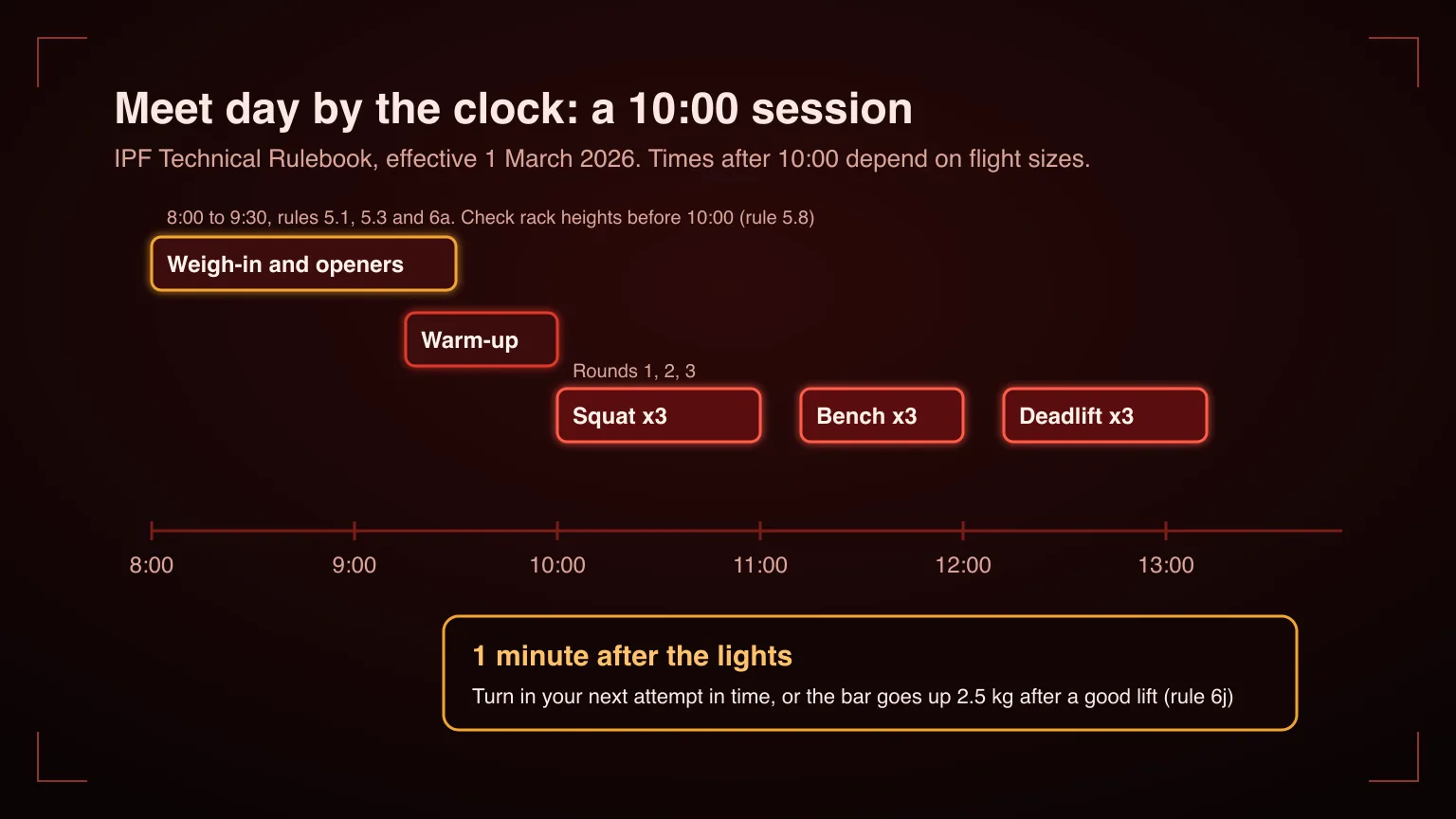
Here is a meet day for a session that starts at 10:00, under IPF rules:
- 8:00 to 9:30, weigh-in. You weigh in once, in a closed room, and may re-weigh only within the hour and a half if you miss your class (rules 5.1, 5.3 and 5.6). At the weigh-in you declare your three openers on your attempt card (rule 6a).
- Before lifting starts, rack heights. Check your squat and bench rack heights and foot blocks and sign the rack height sheet (rule 5.8).
- About 45 to 60 minutes before your flight, warm up. Time your last warm-up so you finish a few lifters before your name comes up. The meet warm-up calculator builds the ramp to your opener.
- 10:00, squats. Every lifter takes a first attempt in round one, a second in round two and a third in round three.
- Between attempts, one minute. You or your handler must turn in your next weight within one minute of the lights. Miss it and you get 2.5 kg more after a good lift, or the same weight after a miss (rule 6j).
- Bench press, then deadlift. You may change your opener once per lift. Seconds cannot change, thirds on the squat and bench press cannot change, and you get two changes on your third deadlift (rules 6i, 6k and 6l).
After each attempt, each of the three referees shows a white light for a good lift or a red light for no lift, then raises a card that names the fault.
Fix the mistakes first-time lifters make
- You open too heavy. Open at about 90 to 92% of your best gym single, the range the meet data support.
- You jump too far. Keep second-attempt jumps to the ranges above, and smaller on the bench press.
- You move before the command. Rehearse "Squat", "Press" and "Down" on every heavy single for the last month.
- You cut weight for your first meet. Lift in your class, eat normally and learn the meet.
- You skip the rack height check. A wrong height costs you energy on the walkout or the unrack. Check it and sign the sheet.
- You warm up too early. Count the lifters ahead of you and start your last warm-up a few lifters before your turn.
- You chase a total. Your first meet sets your baseline. Nine good lifts give you a total to beat at the next one.
Get quick answers
What should I open with at my first powerlifting meet?
Open at about 90 to 92% of your best recent single on each lift. Lifters in one large data set opened their squat at 92% of the best squat they made that day, and almost all of them went on to lift more.
How long does a powerlifting meet last?
Plan for most of a day. The weigh-in alone runs an hour and a half and starts up to two hours before lifting, then you take nine attempts with warm-ups before each lift. Large flights and multiple sessions stretch it further.
What do you need to bring to a powerlifting meet?
Your federation membership card, a photo ID, a singlet, an allowed t-shirt and underwear, lifting shoes, approved belt, sleeves and wraps, food, water and a written attempt plan.
How much should you jump between attempts?
In a study of 93,333 IPF lifters, men's squat and deadlift success rose with jumps of 5 to 20 kg and fell past 20 kg, and bench press jumps worked best under 10 kg. Women did best with smaller jumps: up to 8 kg on the squat and about 9 to 11 kg on the deadlift.
Should you cut weight for your first meet?
No. Lift in the class you already weigh. With a two-hour weigh-in you have little time to refill, and cuts past 5% of body mass often cost performance.
Can you wear knee sleeves at a powerlifting meet?
Yes, under IPF rules: approved knee sleeves up to 7 mm thick and 30 cm long are allowed, and knee wraps only in equipped competitions (rules 3.8 and 3.9). Wrist wraps can run up to 1 m long and 8 cm wide. Other federations publish their own lists, so check yours before you buy anything.
Check the sources
- IPF Technical Rulebook, effective 1 March 2026
- Travis, Pritchard, Mujika and colleagues, Characterizing the tapering practices of United States and Canadian raw powerlifters, J Strength Cond Res, 2021
- Burke, Carroll, Travis and colleagues, Two days versus four days of training cessation following a step-taper in powerlifters, J Strength Cond Res, 2023
- Howells, Spathis, Pearson and colleagues, Impacts of squat attempt weight selection and success on powerlifting performance, J Sports Med Phys Fitness, 2022
- Darragh, Egan, Nolan and Bennett, Predicting a successful attempt in raw powerlifting, J Strength Cond Res, 2026
- Nolan, Lynch and Egan, Self-reported prevalence, magnitude, and methods of rapid weight loss in competitive powerlifters, J Strength Cond Res, 2022
- Campbell, Martin, Bargh and colleagues, A comparison of rapid weight loss practices within international, national and regional powerlifters, Nutr Health, 2025
- Renner, Helms, Kwan and colleagues, Short term body mass manipulation in powerlifting, J Int Soc Sports Nutr, 2025